
The Biggest Federal HVAC Opportunities Are Hiding in Bus Garages

Close your eyes and picture where the federal government spends its heating-and-cooling money, and you will almost certainly picture an airport. The mental image is vivid and hard to shake: a soaring glass terminal, ductwork the size of subway tunnels, and rooftop chillers straining against a July heat wave.
The data points somewhere less glamorous. Across 46 federal awards with HVAC work in scope, airports finished last in total award value. Transit facilities carried more than eight times as much.
The surprise was not only where the money went. It was how the opportunities appeared. HVAC replacement was often buried inside broader projects for bus garages, operating bases, rail yards, and maintenance facilities. A vendor waiting for a solicitation labeled “HVAC” could miss both the size of the market and the earliest chance to pursue it.
Finding 1
The obvious market was the smallest
The number of projects initially makes airports look like a promising market. Airports appeared more often than schools in the 46 award records we reviewed. Yet they received the least total award value of the three facility categories.
Transit facilities appeared in 20 records and carried $353.2 million in award value. Schools carried $90.3 million. Airports finished a distant third at $43.2 million, despite appearing in more records than schools.
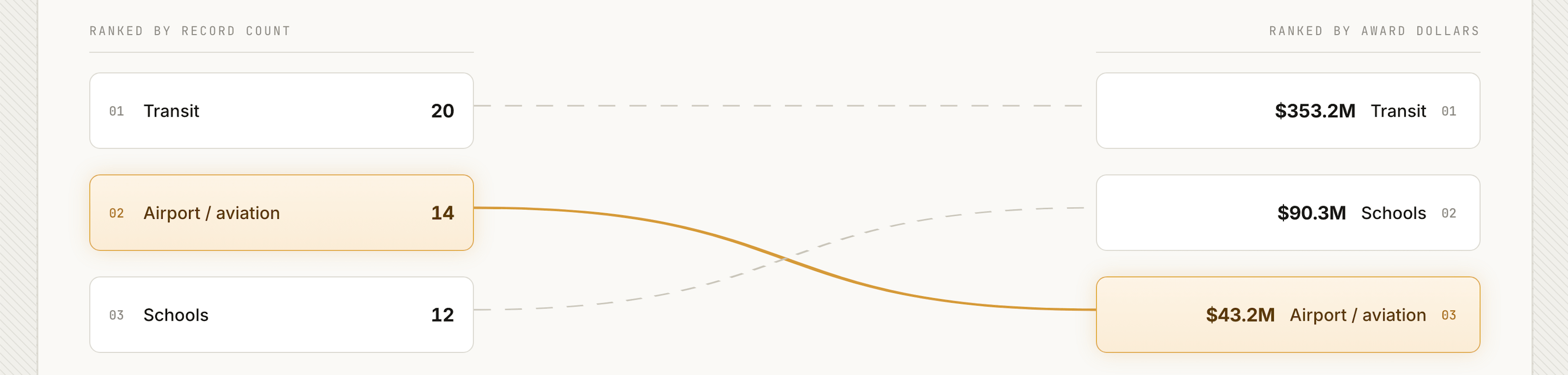
That difference exposes a common problem in public-sector market research. Counting records can make an active category look valuable even when the individual projects are small. A category with fewer but much larger capital programs may represent the stronger sales opportunity.
Finding 2
The largest HVAC projects did not look like HVAC projects
The biggest transit awards were not presented as standalone HVAC projects. They were broad capital programs covering entire facilities, with heating and cooling work included alongside roofs, pavement, electrical systems, fueling infrastructure, and other improvements.
That packaging matters. A vendor searching for projects with “HVAC” in the title would have little reason to open a grant described as a transit base refurbishment or a state-of-good-repair program. Yet that is where some of the largest HVAC-related opportunities appeared.
King County Metro in Washington offers one example. Two federal awards named HVAC replacement within larger transit facility programs. Neither record was a posted HVAC solicitation. The work appeared inside broader plans to rehabilitate the facilities where buses are stored, serviced, fueled, and repaired.
One of those projects was the $58.4 million refurbishment of King County Metro’s Atlantic Base. HVAC was part of the scope, but it was not the identity of the project. To a transit agency, the work belonged to a larger effort to keep a critical operating facility functional. To an HVAC vendor, it represented a funded project that could be easy to overlook.

Greater Cleveland Regional Transit Authority shows the same pattern at a much larger scale.
The agency received a $115.7 million state-of-good-repair award and a $55.2 million follow-on award. Both included HVAC and roofing work within broader capital programs for buses and transit facilities.
Together, the two awards carried $170.9 million in total value. That does not mean $170.9 million was reserved exclusively for HVAC. It means HVAC vendors had relevant work inside two of the largest transit capital programs in the entire dataset.
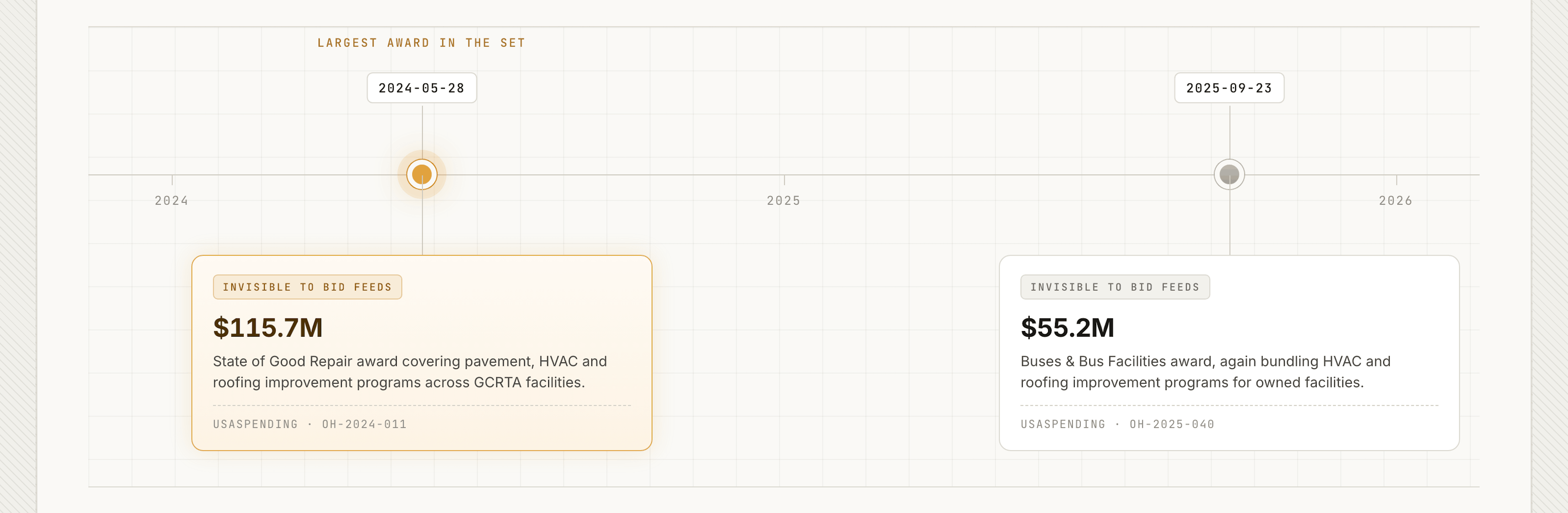
That distinction is essential. These are HVAC-bearing awards, not HVAC-only contracts. The full project value includes other improvements. Even so, the records identify funded facilities, named project scopes, responsible agencies, and capital programs that an HVAC seller would want to investigate.
King County and Cleveland reveal why these opportunities are so easy to miss. The work is real, but it is described in the language of the buyer. Transit agencies speak about base rehabilitation, fleet support, facility modernization, and state of good repair. They do not necessarily describe the project according to the product category a vendor sells.
Finding 3
The Dollar Gap widened at the top of the market
Transit facilities accounted for roughly 73 percent of the $486.7 million in total award value represented in the dataset. For every $1 attached to an airport award with HVAC in scope, more than $8 appeared in transit.
The difference became even larger among the biggest projects. Every award above $10 million was connected to either a transit facility or a school. Not one airport award crossed that threshold.
Transit had seven awards above $10 million. Schools had three. The largest airport award, a $9.88 million project in Redmond, Oregon, fell just below the line.
The largest transit award was Greater Cleveland RTA’s $115.7 million state-of-good-repair program. It was nearly 12 times the size of the largest airport award in the dataset. King County’s $58.4 million Atlantic Base refurbishment also exceeded every airport project by a wide margin.
Schools produced several large opportunities of their own. A $42.3 million Massachusetts school microgrid project included HVAC improvements within a broader energy program. Once again, the heating and cooling work was present, but it was packaged inside a project with a different headline.
The pattern is consistent. The largest opportunities were rarely labeled as simple HVAC replacements. They appeared inside major programs designed to modernize buildings, improve resilience, or extend the life of public infrastructure.

The market was concentrated in a few states
Transit HVAC-bearing award value was not spread evenly across the country. A handful of states accounted for most of the total.
Ohio led with $175.3 million, driven largely by the two Greater Cleveland RTA awards. Washington followed at $62.9 million, with King County responsible for much of that activity. California carried $40.4 million, New York $33.6 million, and North Carolina $20.6 million.

These totals should not be treated as direct estimates of HVAC contract value. The underlying awards often include roofing, pavement, track, rolling stock, electrical work, and other capital expenses alongside HVAC. The actual amount available to a mechanical contractor or equipment provider would be smaller.
For a sales team, that can turn a national market into a practical territory plan. Ohio and Washington would not stand out because they posted the most HVAC bids. They would stand out because large transit capital programs were already creating funded work inside specific facilities.
What HVAC vendors should take from this
- The first lesson is that the most visible market is not always the largest one. Airports produced plenty of records, but transit facilities carried far more award value.
- The second is that government buyers do not organize projects around a vendor’s search terms. HVAC work can sit inside a bus-base renovation, a state-of-good-repair program, a school microgrid, or a broader energy project. The project title may never use the language the seller expects.
- The third is that early records trade certainty for time. A capital plan will not contain the detail of an RFP. A grant may not reveal the final procurement path. But those records can show where a funded need is developing while a sales team can still investigate it.
This applies well beyond HVAC. A security vendor may find cameras inside a school construction program. A fleet technology company may find its opportunity inside a transit modernization grant. A software provider may discover a future purchase in a budget request or committee discussion long before the project is labeled as a technology procurement.
Public-sector opportunities often become visible before they become searchable.
The verdict
The claim we tested was straightforward: airports receive more federal HVAC funding than any other facility type.
The records showed the opposite.
Airports finished last in total award value, behind both schools and transit. Transit facilities carried $353.2 million, more than eight times the $43.2 million associated with airports. The largest opportunities were concentrated in bus garages, maintenance bases, rail facilities, and other buildings that rarely come to mind when someone imagines a major HVAC project.
The more useful finding is not that vendors should abandon airports and chase every transit grant. It is that market assumptions and bid keywords are not enough to reveal where government demand is forming.
The project may not be labeled HVAC. The first signal may not be a solicitation. The buyer may describe the opportunity as facility modernization, energy resilience, or state of good repair.
The work is still there.
See the deal before it becomes a bid. Tell us what you sell, and we will show you where demand is forming in your market, in budgets, council actions, and grant awards, before a solicitation is posted. Book a demo.
Methodology: this report draws on NationGraph's index of public records, including solicitations, budgets, council and committee minutes, grant awards, and contracts, through mid-2026. Each finding traces to a primary public source.


Find your first opportunity in minutes