The World Cup Set Off a $250 Million Counter-Drone Funding Wave

The 2026 World Cup created a security deadline that public agencies could not move. Stadiums would be full, recreational drones would be easy to obtain, and host governments needed the ability to detect and stop an aerial threat before the first match began.
The federal government responded with $250 million in counter-drone funding across the 11 states hosting matches and the National Capital Region. The money created a sizable public-sector market, but it did not arrive in the form most vendors are trained to watch. There was no single list of upcoming purchases and no matching wave of RFPs.
NationGraph reviewed 173 public records to see how the market actually appeared. The most important records were not the ones that announced a completed purchase. They were the earlier, less complete records that showed where money was moving, which agencies were involved, and where a seller still had time to enter the conversation.
Finding 1
Most of the records were noise
The 173 records included drone shows, event permits, routine police activity, policy discussions, and general security planning. They were related to drones or the World Cup, but most did not indicate that an agency was preparing to buy counter-drone technology.
That is an important distinction for any company selling into state, local, or education markets. Government records contain an enormous amount of activity, but only a small share of it changes what a sales team should do. A useful buying signal should reveal something concrete: available funding, a responsible agency, a defined need, an approaching deadline, or movement toward a decision.
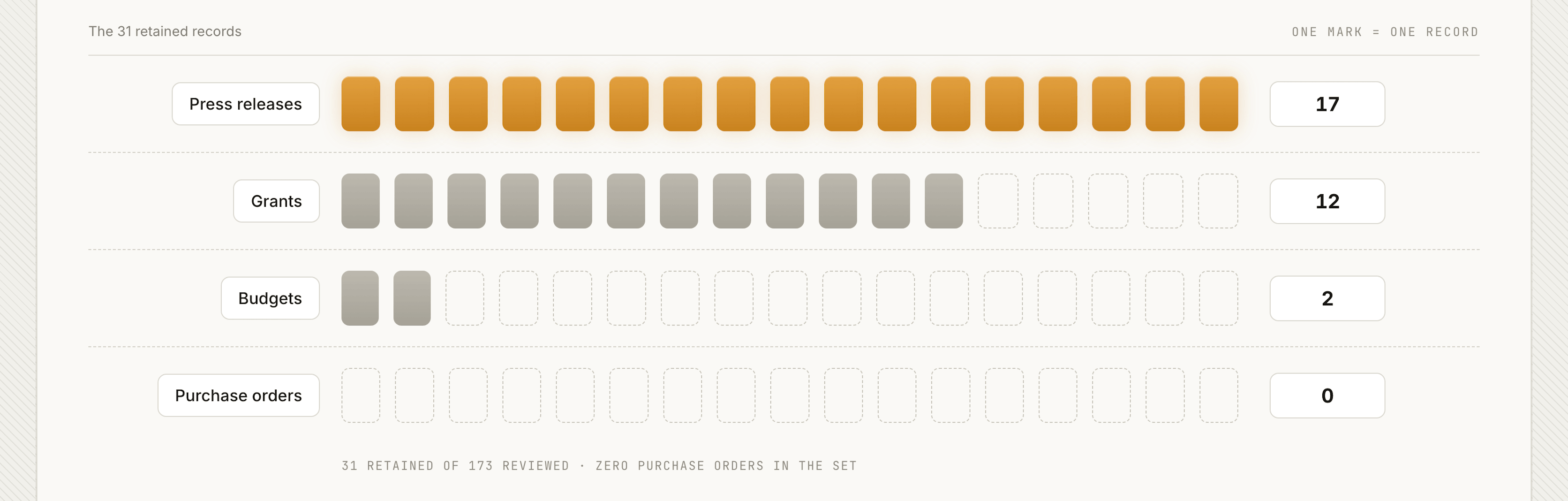
Only 31 records met that standard. 17 were press releases, 12 were grant records, and 2 were budgets. None were purchase orders.
Finding 2
Federal funding created the first real map of the market
The first strong buying signal was the money.
FEMA awarded $250 million for counter-unmanned aircraft system capabilities across 12 jurisdictions. Eleven recipients were states hosting World Cup matches. The National Capital Region was the twelfth.
That funding immediately narrowed the market. A counter-drone vendor no longer needed to treat every state and local agency in the country as an equal prospect. The awards identified 12 jurisdictions with a recognized security need, federal support, and a fixed deadline for deployment.
California received the largest award at roughly $34.6 million. Texas received approximately $30.3 million, while Massachusetts received about $21.9 million in the federal award data. Together, those three jurisdictions accounted for roughly one-third of the program.
.png)
The grants did not reveal which products the agencies would choose. They did not show how much would go toward equipment, whether an existing contract would be used, or whether a public solicitation would ever appear.
They did not need to.
At this stage, the value of the signal was direction. The awards showed vendors where funded demand was likely to develop, which territories deserved more attention, and which public offices controlled the money.
Finding 3
Massachusetts and Texas revealed the value of timing
The federal awards identified where the market was forming. Later announcements showed how quickly the value of a buying signal could change.
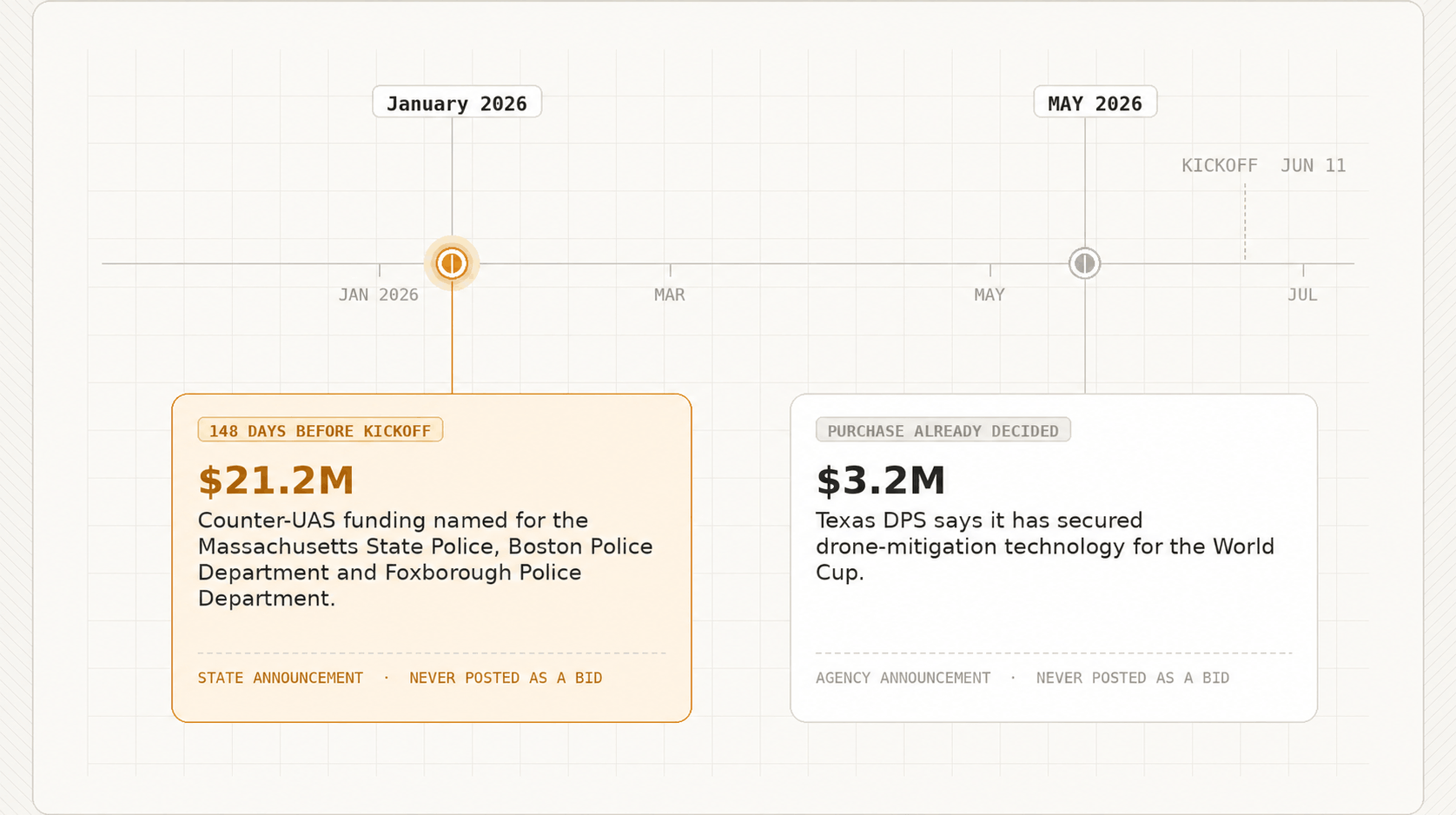
On January 14, 2026, Massachusetts announced $21.2 million in counter-drone funding for the Massachusetts State Police, Boston Police Department, and Foxborough Police Department. The state tied the funding directly to World Cup security and the protection of other major public events.
The announcement came 148 days before the tournament began.
Texas followed a different timeline. The state received roughly $30.3 million through the federal program, making it one of the largest recipients in the country. That award was the early signal. It showed that substantial funding was moving into Texas for a defined security need, even though it did not identify a specific purchase.
Then, in May 2026, the Texas Department of Public Safety announced that it had secured roughly $3.2 million in drone-mitigation technology for the World Cup.
That announcement contained more detail than the original grant, but it was less valuable to a seller. Texas was no longer describing a need or preparing for a purchase. The technology had already been secured.
The pattern behind the cases
No single record explained the entire counter-drone market. The opportunity emerged through a sequence of public actions that added more detail over time.
The World Cup made that sequence easier to observe because the deadline was fixed. Once the host cities and match dates were known, public agencies had to work backward from kickoff. They needed time to assess the threat, obtain funding, assign responsibility, define what they needed, and deploy the technology.
The records show five stages:
- The event starts the clock. A major event creates a deadline and forces public agencies to identify security gaps.
- Funding creates the market. Grants and budgets show where governments have the resources to address the need.
- Agencies name the recipients. State and agency announcements identify the departments that will control or spend the money.
- The use case becomes specific. The funding is connected to a location, operational problem, and deadline.
- The purchase is confirmed. An agency announces that it has approved, selected, or secured the technology.

The most useful window for a vendor sits between stages two and four. Funding exists, agencies are naming priorities, and the final approach may still be taking shape.
By stage five, the public record serves a different purpose. It explains what happened. It no longer reveals an opportunity that a new vendor can meaningfully influence.
The next clock may already be running
A similar planning cycle may be beginning around the 2028 Los Angeles Olympics. Los Angeles County agencies have started discussing the Olympics alongside the World Cup in their drone and counter-drone planning.
That is not proof that a major purchase is coming. It is too early to know whether the discussions will lead to a funded project. However, a planning discussion becomes more meaningful when it is followed by a grant application. A grant becomes more meaningful when an agency is named. A budget becomes more urgent when it is tied to a fixed operational deadline.
A vendor that begins tracking Los Angeles after a purchase is announced will understand what happened. A vendor that follows the earlier records may understand what is forming while there is still time to respond.
Verdict
The World Cup created a visible counter-drone market before a matching RFP appeared. Federal grants showed where the money was going, while Massachusetts and Texas later showed the buyers, dollars and use cases. Major events pull security planning forward. Sellers who follow the early records can see the market taking shape while there is still time to act.
See the deal before it becomes a bid. Tell us what you sell, and we will show you where demand is forming in your market, in budgets, council actions, and grant awards, before a solicitation is posted. Book a demo.
Methodology: this report draws on NationGraph's index of public records, including solicitations, budgets, council and committee minutes, grant awards, and contracts, through mid-2026. Figures reflect counts of records rather than dollar amounts and represent a conservative floor. Each finding traces to a primary public source.
Find your first opportunity in minutes