Marketing to Government: How the Playbook Is Changing

Marketers focused on the public sector are sounding the alarm. In our Q1 2026 survey of marketing leaders selling technology into government, one theme came through louder than anything else: what worked before isn't working anymore.
The average respondent has 7.5 years of experience marketing specifically to government, and several have had longer B2B or retail marketing experience. These leaders have seen cycles come and go. And they're telling us this one is different.
The State of Play Has Changed, Now the Playbook Has to Change Too
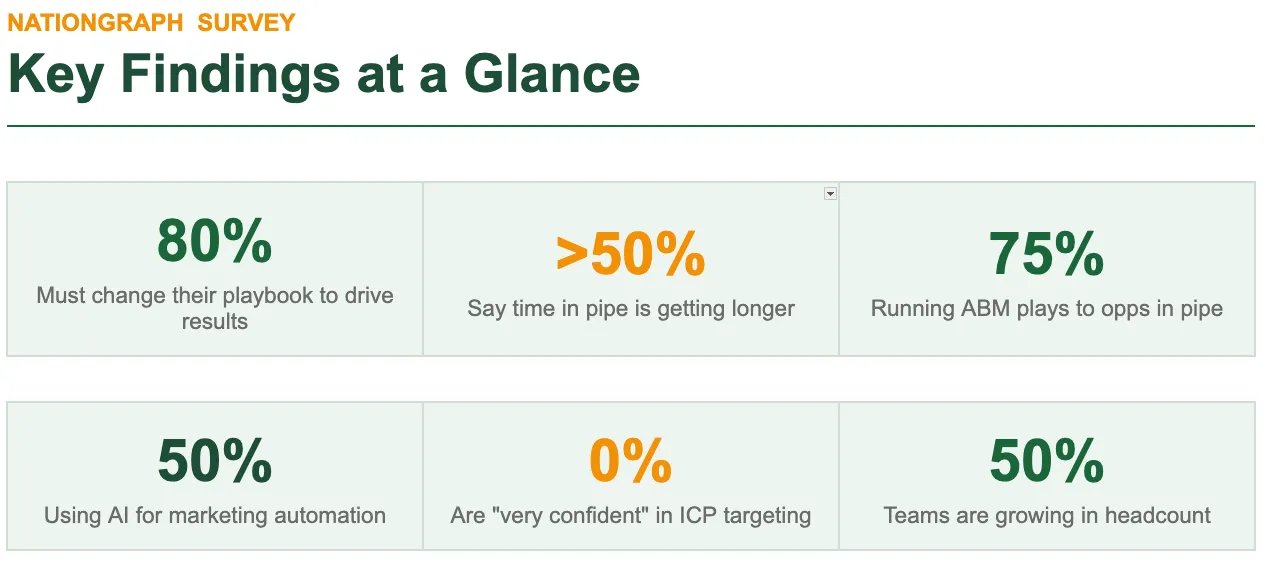
80% of respondents say they must change their marketing playbook to drive the same or better results. Only a small minority report that their existing motions are still producing at prior-year levels.
This isn't subtle. A large majority of marketing leaders are actively rethinking their approach — reworking campaigns, rethinking channels, and reconsidering how they identify and prioritize accounts.
Deal Cycles Are Getting Longer
More than half of respondents say time in pipe is increasing. Deals are taking longer to close, and the pipeline is stretching. Only a small share report shorter cycles, while the rest say things are holding steady.
For teams already under pressure to hit pipeline targets, longer cycles mean every bet on where to focus has to be sharper. There's less room to waste time on accounts that were never going to close.
Teams Are Leaner -- and Juggling More
The picture gets more complicated when you look at team structure. While half of marketing teams are growing headcount, others have gotten leaner. And across the board, the workload is expanding: half of teams are promoting 10 or more products, solutions, or services simultaneously.
Most teams lean toward demand generation over product marketing, and some lack formal roles for either function entirely. The result is a small number of people covering an enormous surface area – making prioritization not just important but existential.
Thankfully, the era of 'go to all the shows' is over as budgets are scaled back and as marketers have been able to demonstrate where there was value in sponsorships and where there was not. (Even sellers we surveyed separately talked about their desire to scale back show attendance.)
Pipeline Ownership Differs Across Companies
When we asked how much pipeline marketing owns, the answers were split. Some teams own 25–30% or more, but half have no specific marketing attribution goal at all.
That's a structural problem. Without clear ownership, it's hard to prove impact, justify budget, or make the case for the tools and headcount needed to compete.
ABM Is Becoming a Critical Motion for Marketing to Show Value
75% of respondents are intentionally marketing to contacts on active opportunities to help advance deals already in pipeline. This is a clear signal that account-based motions – not just top-of-funnel volume plays – are becoming standard operating procedure in marketing.
This is the area where marketers can really shine because they can often help with multi-threading – engaging all the key people in a buying decision with content aimed at accelerating decision making. They can also help buyers buy with playbooks and plan letters that help accelerate deal velocity.
SDR/BDR teams overwhelmingly report outside of marketing, which means tight coordination between sales and marketing is more important than ever, even as org structures keep them apart. Thankfully, new AI tools help ensure coordinated outbounds to the right contacts with the right messages, which is something that previously took too much time away from other, more strategic motions.
Where Marketers Look for Signals
We asked what data and signals marketers use to decide where to focus. The answers painted a picture of teams hungry for intelligence but cobbling it together from scattered sources:
* Modernization initiatives and digital transformation mandates were the most commonly cited signals
* Open RFPs, legislative and regulatory changes, and executive orders came up frequently
* Leadership changes, federal grants and funding shifts, and cyber risk events rounded out the list
* Several respondents also look at agency headcount, competitor activity, innovation readiness, and AI adoption signals
The common thread: marketers want to know where the money, the mandate, and the momentum are – but most are assembling that picture manually.
Defining the Ideal Customer Is Universal -- Still But Fuzzy
When asked how their organization defines best-fit or ICP buyers, agency type and current-state process/solution were universal criteria – every respondent uses them. Laws, rules, codes, strategic initiatives, and news or risk events were close behind. Budget, population, and competitor presence showed up as secondary factors.
The criteria are reasonable. The challenge is confidence.
Nobody Is ‘Very Confident’ in Their Targeting
Here's the stat that should make every marketing leader pause: zero respondents said they are "very confident" that their teams are focused on best-fit prospects. The vast majority reported being only "somewhat confident."
Think about that. Experienced marketers, with mature ICP definitions and increasingly sophisticated tools, still can't say with conviction that they're pointed at the right accounts. That's not a people problem – it's an intelligence gap.
AI Adoption Is Underway – But Uneven
Half of the marketers surveyed are using AI for marketing automation (think lead nurturing, campaign workflows, and content generation). A smaller share have extended AI into SDR/BDR outbound messaging. And the remaining half haven't adopted AI for automation at all.
The divide is notable. Teams using AI for both automation and outbound are effectively multiplying their capacity, while teams without it are falling further behind – especially as sales cycles lengthen and headcount stays flat.
What Marketers Wish They Knew
We closed with an open-ended question: "What information do you wish you knew about your prospect universe?" The answers were revealing:
"All required stakeholders in an agency, communication channels they use, amount of inbound requests they get across all channels, available grants, openness to innovation/new tech" — Director of Marketing
"What HR and Risk personas in local gov't struggle with the most in their role and what would make their jobs easier" — Customer Marketing Manager
"Pain points with their current vendor (and who that vendor is!)." — Sr. Director, Creative and Content Strategy
"Understanding what tools/workflows they're currently using today and why are they not keen to modernize and move towards technology that helps them do their job better" — CMO
The theme is clear: marketers don't just want contact data or firmographics. They want to understand what's happening inside the agency – the pressures, the workflows, the openness to change – so they can show up with a message that actually resonates.
The Bottom Line
Marketing to government is defined by a painful irony: teams are more experienced, more tool-rich, and more AI-enabled than ever – and yet less confident that they're focused on the right opportunities. Playbooks are breaking. Cycles are lengthening. Teams are stretched thin.
The marketers who will win aren't the ones who run more campaigns. They're the ones who see the signal first – the mandate, the budget shift, the leadership change, the procurement wave – and act on it before the competition even knows to look.
That's what NationGraph was built for.
NationGraph indexes data from approximately 110,000 government entities across roughly four million websites and applies AI reasoning to enable key capabilities:
+ Signals deliver predictive intelligence on government purchasing decisions by cross-referencing all key data sources tailored to each supplier's products and services.
+ Public Record Request Automation unlocks hard-to-access public records at scale. Customers define the data they need, and NationGraph handles the full request, extraction, and delivery process, pushing structured data directly into existing sales platforms and workflows.
+ Contacts uses AI to identify key buyer titles across departments, validate email addresses, and map results to Signals.



Find your first opportunity in minutes