How Local Governments Actually Buy License Plate Cameras

How local governments actually buy license-plate cameras, and why the public bid feed reflects only a fraction of the market.
License-plate readers are cameras that capture passing vehicles and record their plates. Their use by local police departments is growing quickly, and so is the number of companies competing to sell them.
Most vendors track that demand in much the same way: they watch public bid portals for solicitations that mention license-plate readers, then pursue the opportunities that appear. But those notices may reveal only part of the market.
To find out, we reviewed license-plate-camera solicitations issued by local governments across the country in recent years. We then traced each purchase through the public records surrounding it, including meeting minutes, budgets, grants, and approvals.
What we found was a market that is visible, but only in fragments. Public bid feeds are generally accurate, yet they are also incomplete and often late. Roughly two-thirds of buyers never appear in them at all.
Where buyers actually file the purchase
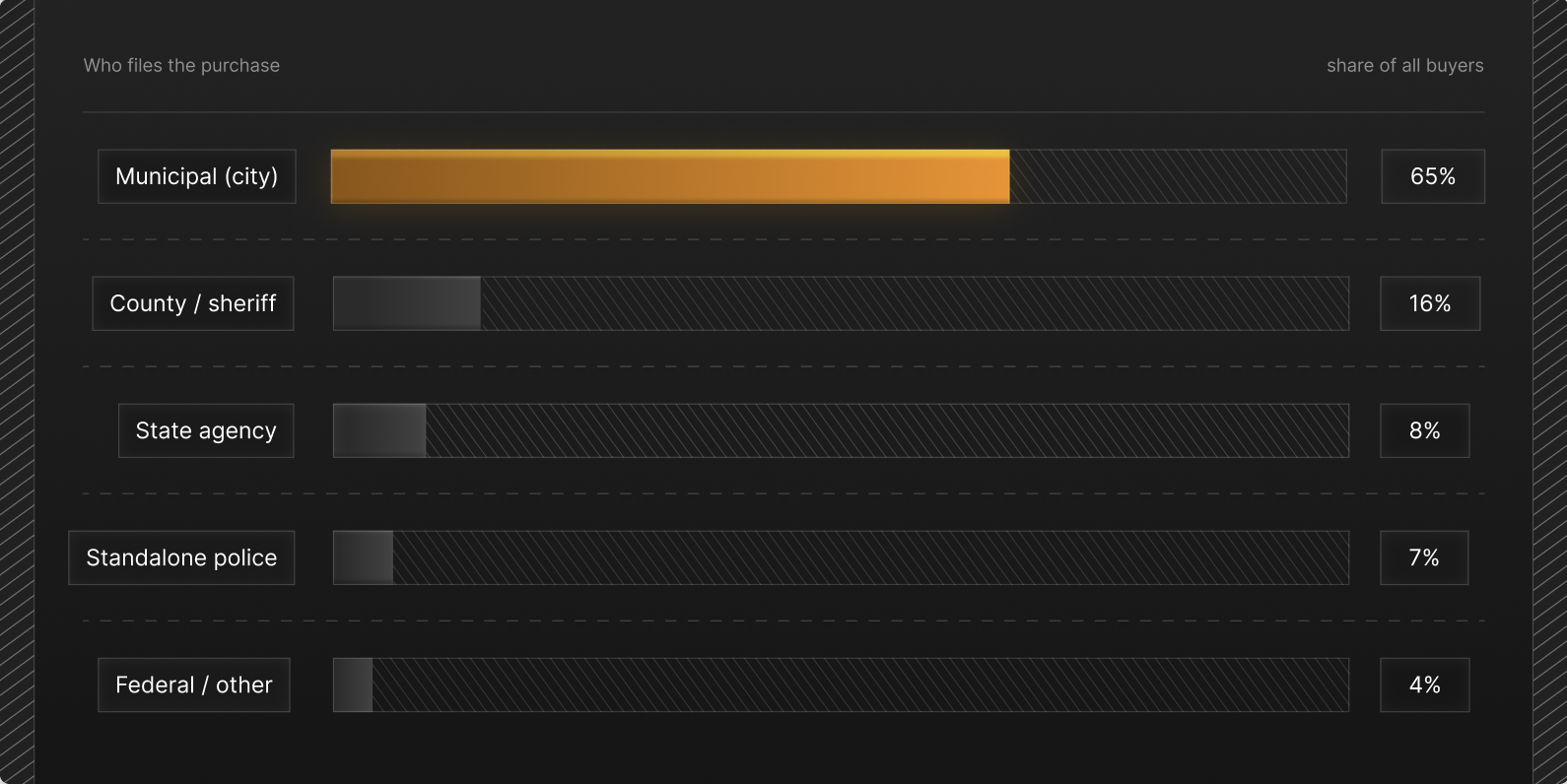
Most buyers are not recorded as police purchases
The first surprise is where these purchases appear in the public record.
When a municipality acquires license-plate cameras, the paperwork usually sits with the city or the county, not the police department. It may appear as a budget line, a council vote, or a grant award.
Roughly two-thirds of buyers file the purchase at the city or county level, while less than 10% appear under a standalone police department. That means a vendor searching only police records is likely to miss most of the market.
By the time a solicitation appears, the decision is largely settled
The second finding concerns timing. When a solicitation does appear, it appears late in the process. By then, the agency often knows what it wants to buy, and in many cases which vendors it prefers. The most important decisions were made earlier, through public meetings, budget approvals, grant awards, and vendor discussions.
An open solicitation may look like an open competition, but the label can be misleading. Roughly 90% of bids in this category are officially open to any vendor, while only a small share identify a sole source. However, the requirements may already reflect a product or system the buyer has chosen. The process is technically open, but the field is often much narrower than it appears.
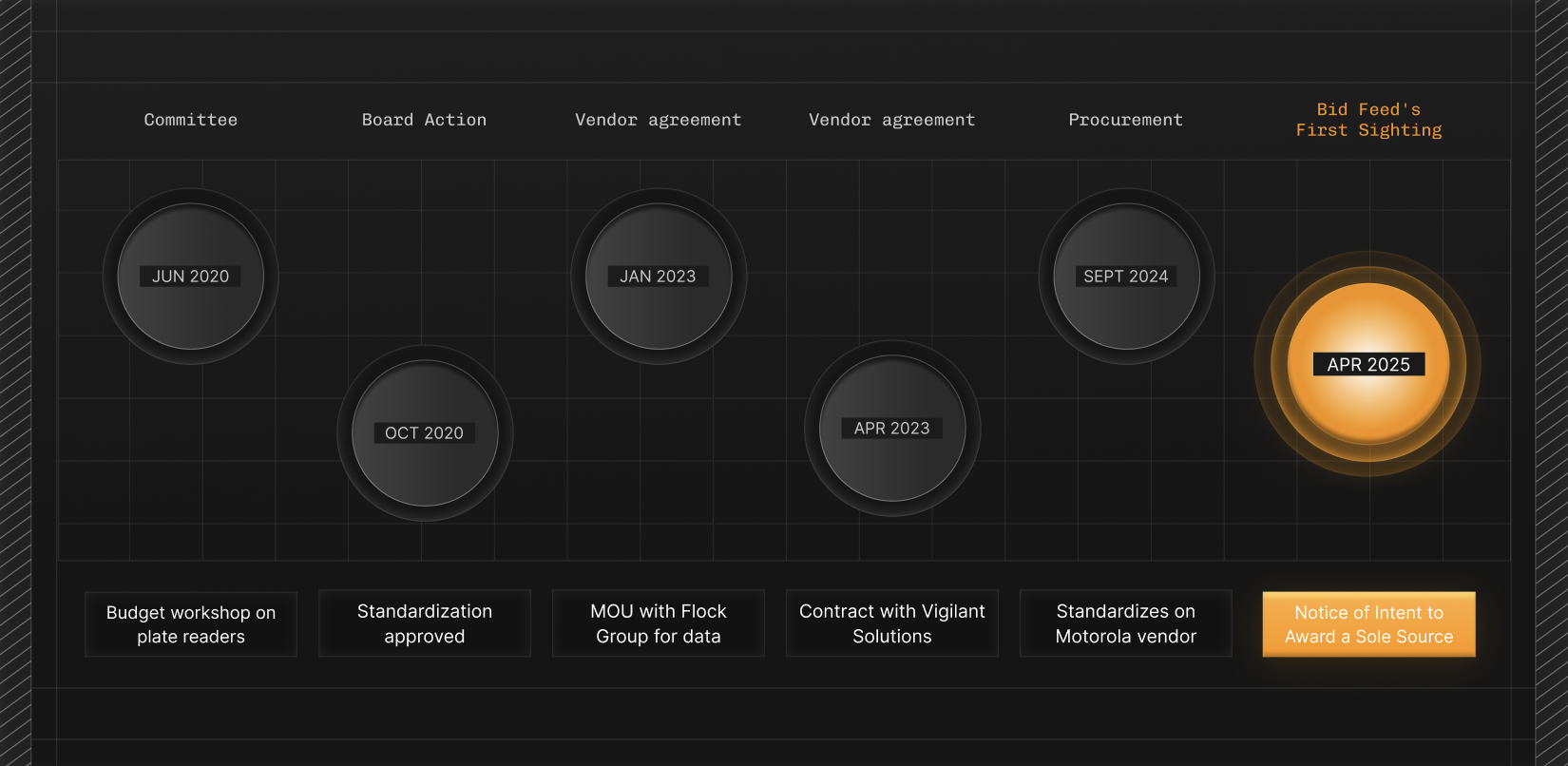
North Port, Florida, shows how this plays out.
The city’s purchase developed gradually and in public over roughly five years. It began with a presentation to the city council and, shortly afterward, the approval of funding. In the years that followed, the city entered a data-sharing agreement with one vendor and a contract with another before standardizing on a single system.
Only at the conclusion did the matter reach the public bid feed, as a notice of intent to purchase from one vendor without competition. Years of public signals preceded that notice; the bid feed registered only the final step, after the outcome had been settled. It recorded the result, not the opportunity that led to it.
East Ridge, Tennessee, followed a different path
The city council approved the purchase in an open meeting and paid for it with a federal grant. Because the council authorized the purchase directly, no camera solicitation was ever posted. The only related item that appeared in a bid feed was a much smaller contract for the electrical work needed to install the system.
A vendor watching for license-plate-camera bids would have seen the wiring and missed the cameras.
North Port and East Ridge took different routes, but they point to the same problem: a sales pipeline built around bid feeds either reaches the opportunity after the important decisions have been made or fails to see it altogether.
The pattern behind the cases
North Port and East Ridge are not exceptions; they reflect how the category functions.
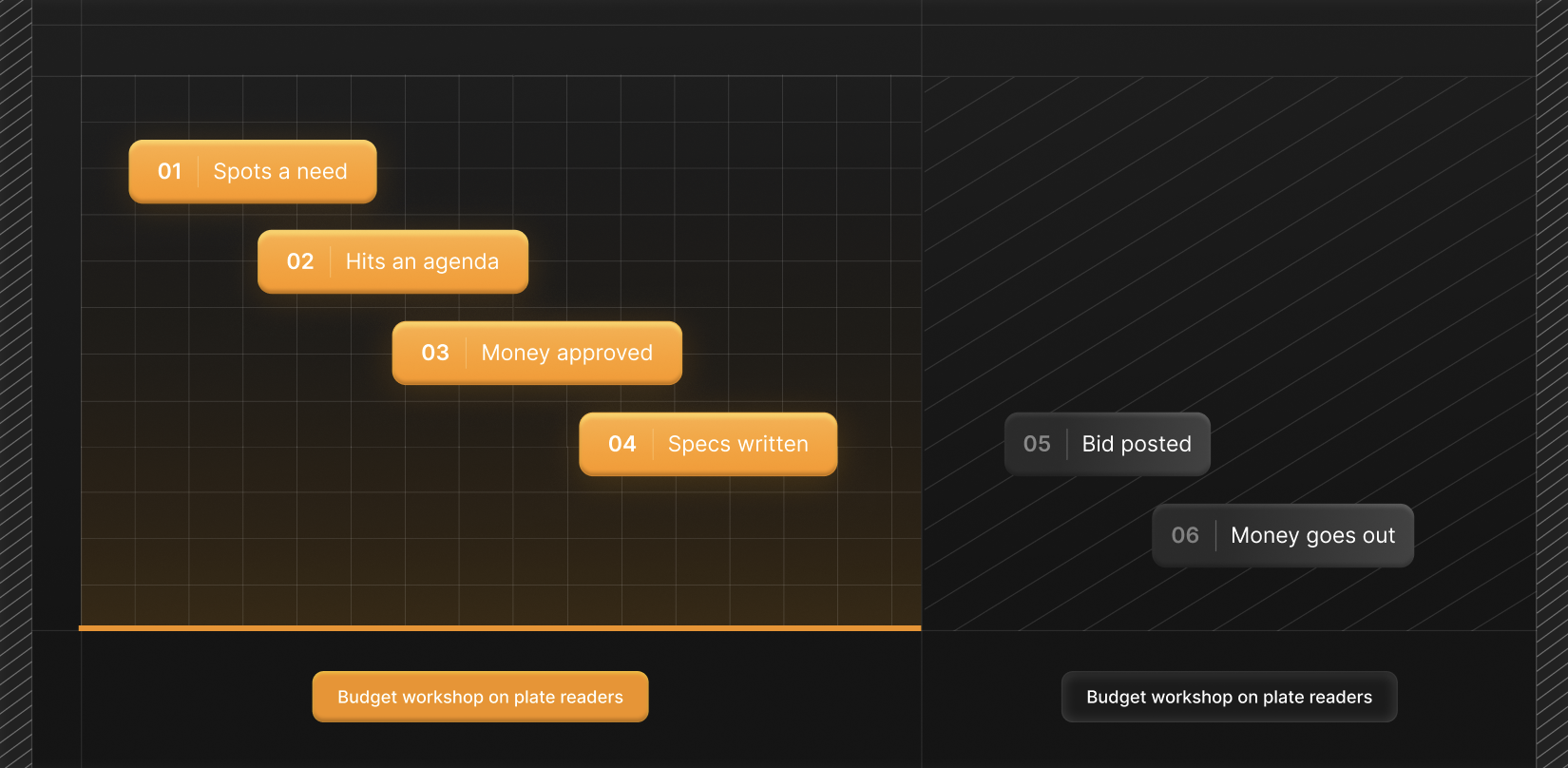
A government purchase generally proceeds through six stages:
- A need is identified, such as a crime trend or a council priority.
- It reaches a meeting agenda.
- Funding is approved, through a budget line or a grant.
- Requirements are drafted.
- A solicitation is posted.
- Payment is issued.
The decision is effectively made across the first four stages. Bid feeds and spending databases begin to observe the process only at the fifth or sixth, once the consequential choices have been made.
The decision is over before the tools start looking
Much of the demand is funded by grants
A further portion of the decision sits outside the procurement process entirely, in federal grants. When a jurisdiction receives a grant for cameras, the award names the recipient, the equipment, and the amount, and is published to a federal spending system rather than a bid feed.
A substantial share of buyers fund their purchases this way, in jurisdictions distributed across every region of the country. Most of that funding flows through a single Department of Justice program, the Byrne Justice Assistance Grants, with the remainder drawn from other federal, state, and homeland-security sources. Once such an award is issued, the purchase is effectively committed, though no bid feed will reflect it.
Implications
Three conclusions follow:
The bid feed confirms demand rather than revealing it. Most solicitations are shaped, and often decided, before they are published. A pipeline that begins at the solicitation competes for decisions already made.
Most buyers are not recorded as police agencies. A police-centric pipeline does not merely identify them late; it does not identify most of them at all.
The predictive signals appear earlier. Budgets, council actions, and grant awards reveal demand forming months or years before any solicitation. Reading them allows a vendor to engage while the decision remains open.
See the deal before it becomes a bid. Tell us what you sell, and we will show you where demand is forming in your market, in budgets, council actions, and grant awards, before a solicitation is posted. Book a demo.
Methodology: this report draws on NationGraph's index of public records, including solicitations, budgets, council and committee minutes, grant awards, and contracts, through mid-2026. Figures reflect counts of records rather than dollar amounts and represent a conservative floor. Each finding traces to a primary public source.




Find your first opportunity in minutes